Antarctica and Its Ocean
download the panelAntarctica is the coldest area on the planet. The Southern Ocean surrounding Antarctica extends to the subtropical front, where fresher, colder subantarctic waters meet saltier, warmer subtropical waters. The interaction zone is marked by the Antarctic Circumpolar Current (ACC), a belt up to 500 km wide, moving eastward and carrying 120–140 million cubic meters of water per second. Near the continent, currents flow opposite to the ACC, generating Antarctic divergence. Circumpolar winds blow westward near the continent and eastward farther north, creating the Ross and Weddell gyres.
The ACC plays a fundamental role in the global energy balance, transferring heat from equatorial to Antarctic regions and acting as a barrier in the marine ecosystem. The Antarctic plateau (2,000–4,500 m elevation) has a cold, desert climate, with annual snow accumulation of about 50 mm.
Large temperature and air density differences between the interior and the coast generate katabatic winds, among the strongest in the world: cold, dense air masses slide from the plateaus to the coast, accelerated by gravity.
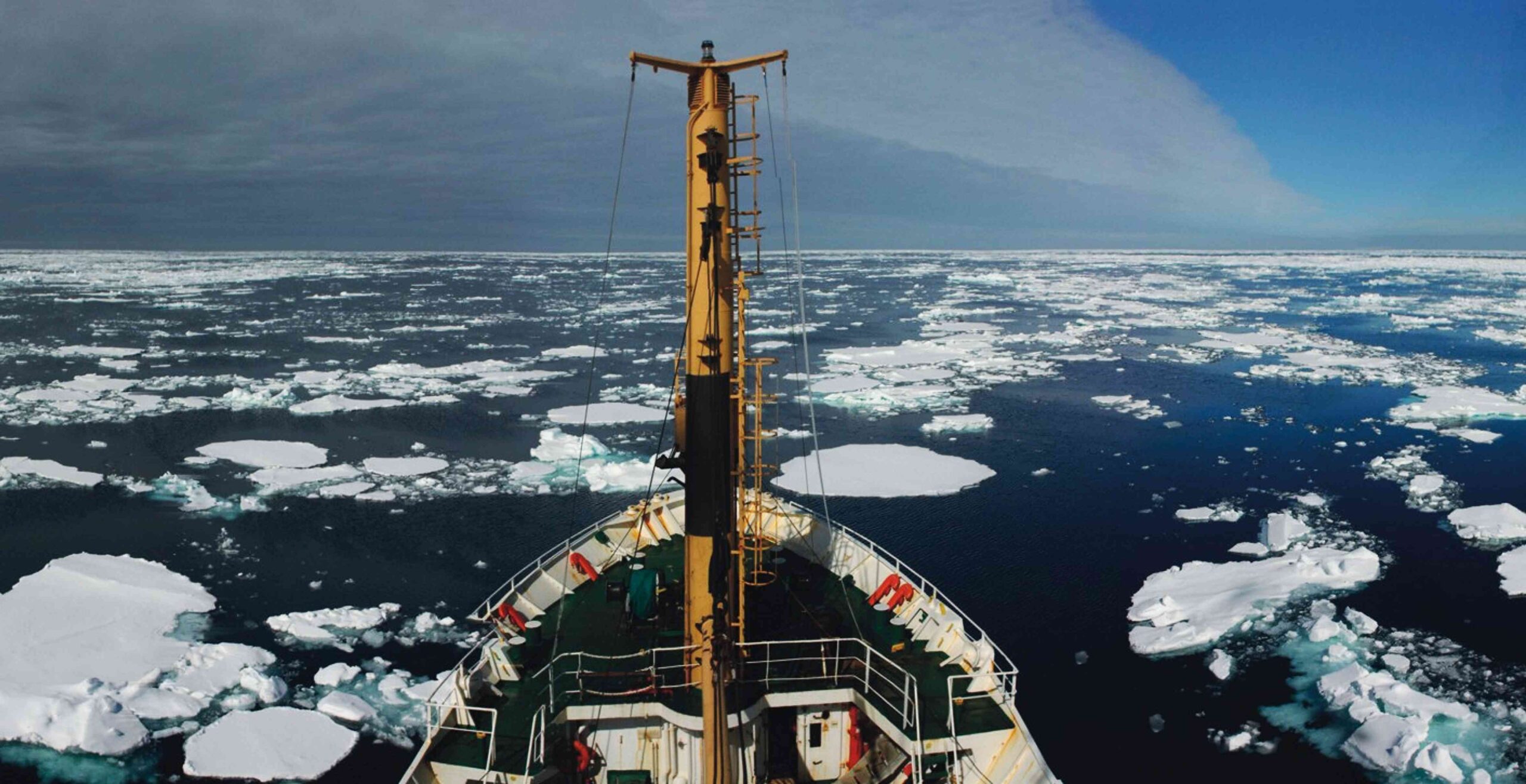
The interaction between the Circumpolar Current and meltwater from Antarctic glaciers makes the Southern Ocean a driving force for global ocean currents. Along the continental margins, the formation of sea ice (pack ice) creates dense, salty water masses that sink, initiating global ocean circulation (the Conveyor Belt).

Catabatic winds over the Antarctic glaciers – Credit: Norman Kuring (NASA Goddard Space Flight Center, retired)

Polynyas – areas of sea free from seasonal sea ice even in winter – intensify this process. Heat exchange with the atmosphere promotes continuous formation of new, thin sea ice and increases water salinity and density.
The transport of cold deep water toward the equator and warm surface water toward the poles helps redistribute heat and absorb atmospheric CO₂.
Without this continuous heat exchange, some regions of Earth would be much hotter or colder than they are today. Oceans and the atmosphere act as a giant “thermostat” for the planet.